Tailored to vehicle imaging

JAI is launching two new high dynamic range CMOS cameras, the TS-4032EN (monochrome and TSC-4032EN (colour), tailored to demanding vehicle imaging and vehicle recognition applications in electronic toll collection, open road tolling, journey time information, speed enforcement, red light enforcement and homeland security.
July 26, 2012 Read time: 2 mins
78 JAI is launching two new high dynamic range CMOS cameras, the TS-4032EN (monochrome and TSC-4032EN (colour), tailored to demanding vehicle imaging and vehicle recognition applications in electronic toll collection, open road tolling, journey time information, speed enforcement, red light enforcement and homeland security.

The new cameras are based on a 43.3mm progressive-scan CMOS sensor providing over three megapixels of resolution (2,048x1,628 active pixels). This enables them to cover more than a full traffic lane with a vertical field of view of 3.7m.

The devices feature no-smear technology eliminating blooming and loss of license plate data due to problems with sun glare or glint. In addition, JAI says that the CMOS sensor's inherent high dynamic range of 66dB, combined with excellent near-IR sensitivity, and a signal-to-noise ratio of greater than 58dB, provides for high image quality in both daylight and night-time conditions.

When coupled with the company's external light sensor technology in a full system configuration, the cameras' dynamic range is significantly increased. The devices also feature internal JPEG compression, automatic FTP transmission of captured images to a file server, and internal clock synchronisation via the Network Time Protocol to ensure consistent date/time stamps in multi-camera installations. A built-in PowerPC processor running real-time Linux OS simplifies the process for in-field maintenance and firmware upgrades.

For more information on companies in this article

Related Content

  • Predicting and solving future transport problems?
    August 10, 2012
    Can the future be predicted? With what accuracy can ‘predictive analytics’ be used to help anticipate demand? This is a relatively new science for transportation and over the next few years it will be interesting to see to what extent it can solve some common problems. Transportation authorities may be close to finding the golden chalice that is accurate prediction of how traffic will behave as congestion occurs. Predictive algorithms are not necessarily new, but the coming together of conditions needed for
  • EDI ushers in new safety era
    April 26, 2023
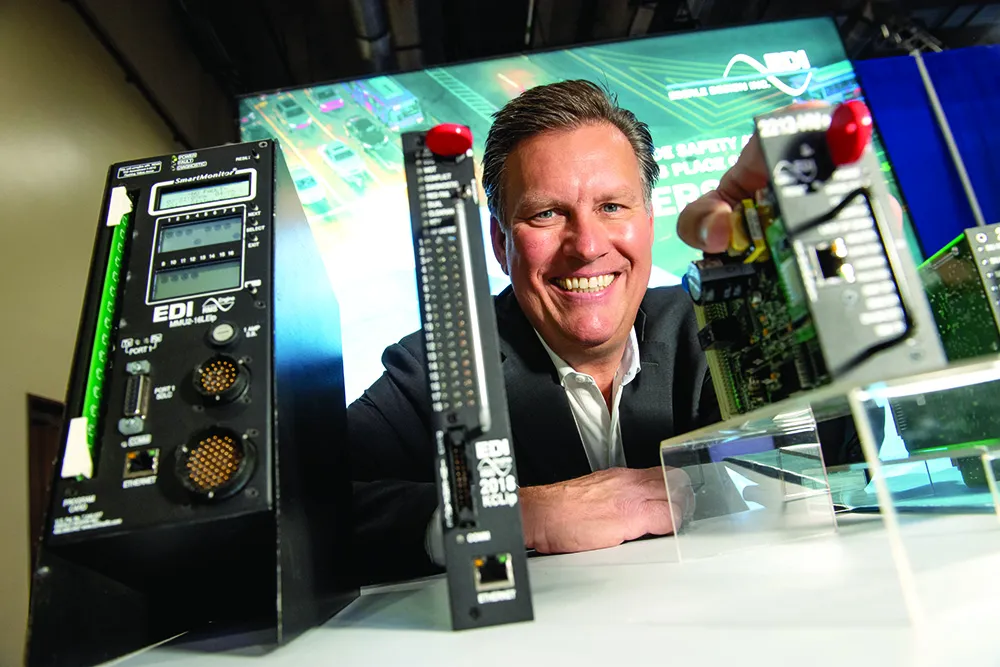
    Traffic control has evolved dramatically over the past century, and it’s reinventing itself once again as cities become more connected while environmental sustainability, multimodal transportation, autonomous vehicles and Big Data take hold.
  • Flashing LEDs may cut ‘distracted walking’ risk
    March 24, 2020
    Flashing LED lights embedded into pavements could improve the safety of pedestrians distracted by their phones, says Australia’s Queensland University of Technology (QUT).
  • Christie offers wide range of stackable video cubes
    September 3, 2015
    The Entero HB range of video cubes from audio and visual specialist Christie offers standard-sized, stackable, rear-screen and front-screen projection cubes. Front access design addresses space limitations with the ability to put the cubes directly up against a wall while maintaining performance, image quality and reliability.