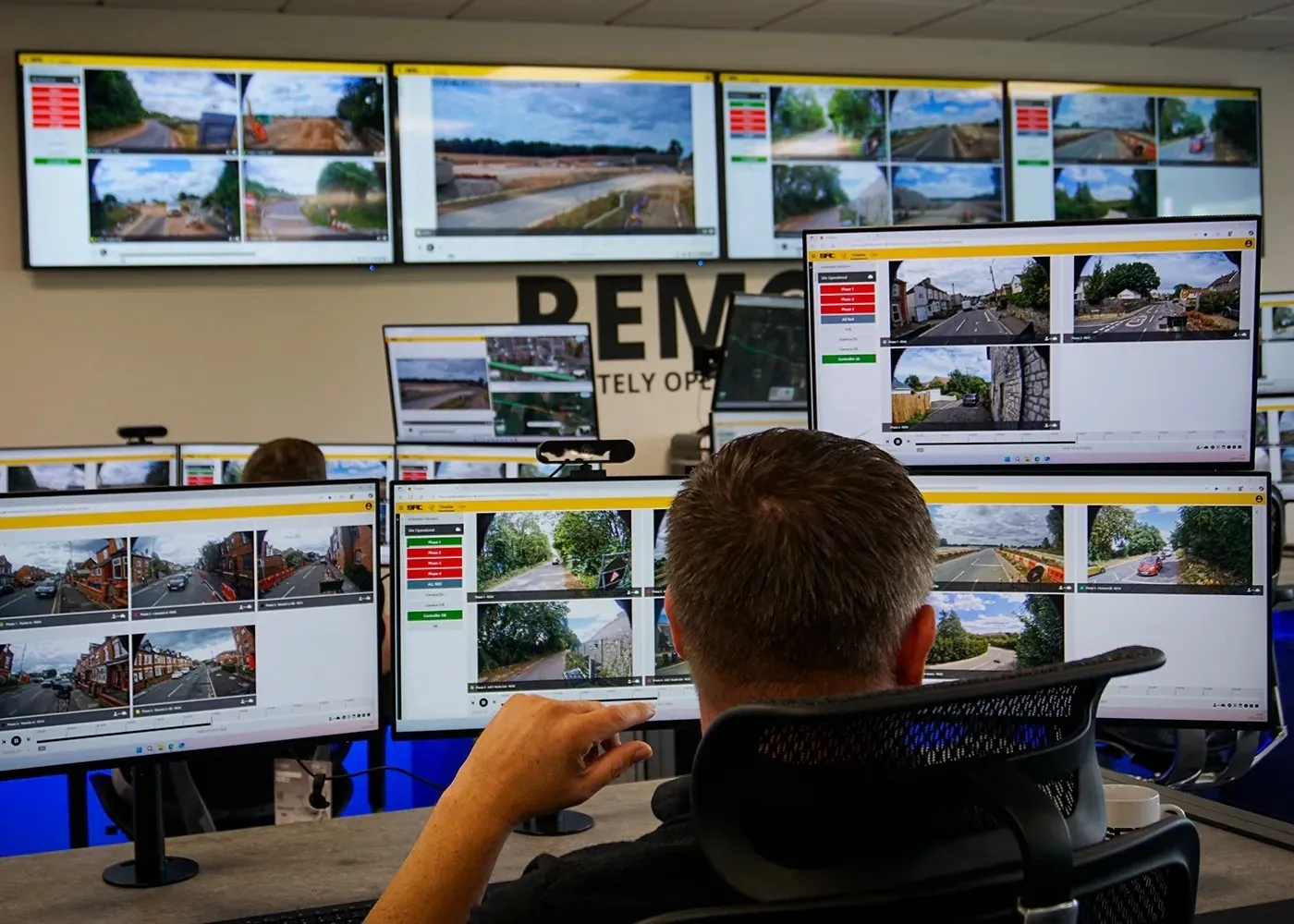
SRL Traffic Systems says its new service Remos (remotely operated signals) minimises the number of personnel stationed on site in live traffic lanes.
The scalable, remotely-operated mobile signal solution was initially created to facilitate off-site operation of portable traffic signals in multiple locations on medium to long-term schemes. It is now also available to highway authorities, contractors and traffic management organisations requiring flexible deployment on shorter-term schemes.
The provision of two service solutions - the original Remos Max and the new Remos Flex - is based on feedback from trials in 2024 and a series of live local authority market familiarisation schemes earlier this year across Greater Manchester and the Midlands in England.
Remos allows one person to manage several sites simultaneously, efficiently making interventions to prevent and eliminate bottlenecks. SRL claims that there is no scope for human error caused by on-site fatigue or inability to see the full system - and the solution performs even in poor weather conditions that may deter on-site personnel.
Remos comprises portable traffic signals equipped with built-in radar sensors and CCTV cameras that detect vehicle movement and stream footage of the approaching traffic.
It captures and transmits data from remote traffic management control (RTMC) boxes to SRL’s control centre in the city of Solihull, where it is analysed in real time to allow interventions for optimal traffic flow.
The newly-created, short-term Remos Flex solution is available for long-term lease in two-, three- or four-way packages.
Customers need only provide SRL with two hours’ notice to commence remote operation and can decide how to allocate up to 12 hours of remote monitoring and control per day, with additional hours available via surcharge. They may switch off the Remos facility whenever required.
When the solution is not being remotely operated, it automatically reverts to SRL’s patented Multiphase Advanced Detection System. A high-precision radar collects real-time data on traffic volumes and speeds and transmits this to signals, with an algorithm dynamically adjusting green times to optimise traffic flow.
Remos Flex also incorporates SRL Solar Plus, the company’s solar traffic signal technology along with absorbed glass mat (AGM) batteries that may be easily and efficiently charged on board.
Its single-person control facilitates reliable operation, even in the face of the frequent staff shortages that characterise the sector and cause roadwork delays. The environmental benefits of the solution are significant. SRL estimates that Remos can save contractors in the region of 3,564kg CO2 pa per operative no longer required on site.