
IRD introduces vehicle information in motion

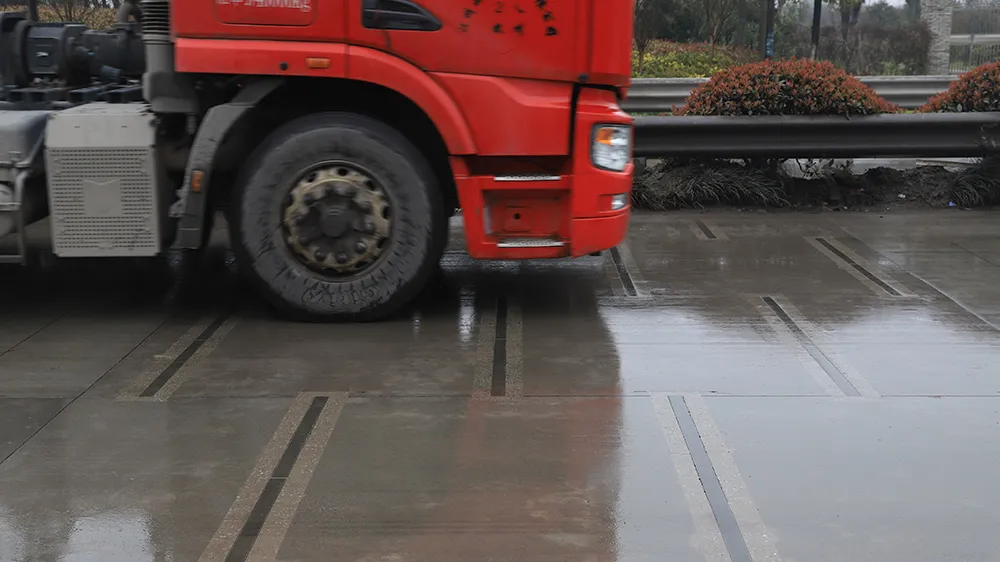
IRD, which is celebrating 35 years in business this year, is here at the ITS America Annual Meeting to introduce VI2M (Vehicle Information in Motion) enforcement systems for data collection and commercial vehicle operations. VI2M enforcement systems use the VectorSense tyre sensor suite in ramp and mainline weigh station bypass solutions as well as for advanced data collection applications. The tyre sensor suite is a new in-road sensor technology that provides vehicle position and individual tyre footprint
June 2, 2015 Read time: 2 mins
Randy Hanson of IRD with the VectorSense technology

857 IRD, which is celebrating 35 years in business this year, is here at the ITS America Annual Meeting to introduce VI2M (Vehicle Information in Motion) enforcement systems for data collection and commercial vehicle operations. VI2M enforcement systems use the VectorSense tyre sensor suite in ramp and mainline weigh station bypass solutions as well as for advanced data collection applications. The tyre sensor suite is a new in-road sensor technology that provides vehicle position and individual tyre footprint information for use in traffic data collection programs, commercial vehicle operations and toll road operations. This additional and advanced vehicle data provides for differentiation between single standard tyre width, ‘super single’ tyre width, and dual tyre width configurations.

This system also provides information to identify tyres that are overinflated or underinflated at highway speeds, presenting new opportunities in data collection and safety as well as weigh station bypass system solutions. IRD says this is unparalleled by any other sensor or system currently available in the market.

In North America, IRD is best known for Weigh-In-Motion (WIM) systems for Commercial Vehicle Operations (CVO) and the company is also presenting its most recent developments in scales, sensors, and complete integrated ITS solutions.

It is showcasing products, software and fully integrated systems for automated truck weigh stations and overweight vehicle enforcement systems, advanced data collection systems, borders and ports security systems, bridge monitoring and safety, access control systems at secure facilities, and automated toll collection and audit systems. As IRD points out, its systems bring together WIM, machine vision, automatic vehicle identification and communications technologies to be a ‘one source, multisolution’ system integrator.

For more information on companies in this article

Related Content

  • Green Light WIM
    July 30, 2012
    Beginning in the 1990s, Oregon was one of the first US states to use weigh-in-motion scales and transponder-based systems to enable trucks to avoid having to stop at weigh stations. Its Green Light preclearance system soon became a model for similar deployments throughout the country. Today, Green Light annually weighs and screens 1.6 million trucks as they approach 21 Oregon weigh stations and it preclears 1.5 million of them.
  • Kistler Lineas strip sensors receive OIML certification
    September 16, 2015
    Kistler has announced that its Weigh-In-Motion (WIM) system consisting of Lineas quartz WIM sensors and the Kistler WIM Data Logger has been OIML R-134 certified. Kistler said its WIM system precisely measure axle loads and vehicle weights from low to high speed. It is now, with the OIML certificate (International Organisation of Legal Meteorology) also certified for legal applications from low to medium speed (3-65 kph) with accuracy class 5 and class 10. This enables the automatic collection of weig
  • WiM checks & balances
    January 11, 2022
    From a legal and safety perspective, making sure your figures are right is a vital element of Weigh in Motion: VanJee, Q-Free, Intercomp and Cross Zlín explain how to achieve this…
  • Machine vision’s image of road management’s future
    June 11, 2015
    Q-Free’s Marco Sinnema looks at how the commoditisation of high-quality vision-based solutions is widening their application. Machine vision technology’s entry into the ITS/traffic management sector has followed a classic top-down path. This is unsurprising given the extremely demanding performance criteria which are the standard in its market of origin, manufacturing processing. Very high image qualities combined with frame rates often in the hundreds per second range resulted in vision systems with capabi




