
Test 7th January 2016 News 1

Lorem ipsum dolor sit amet, consectetur adipiscing elit, sed do eiusmod tempor incididunt ut labore et dolore magna aliqua. Ut enim ad minim veniam Lorem ipsum dolor sit amet, consectetur adipiscing elit, sed do eiusmod tempor incididunt ut labore et dolore magna aliqua. Ut enim ad minim veniamLorem ipsum dolor sit amet, consectetur adipiscing elit, sed do eiusmod tempor incididunt ut labore et dolore magna aliqua. Ut enim ad minim veniam
January 6, 2016 Read time: 2 mins
Sanral has become the subject of much political debate and protests on the streets of South Africa

593 Teledyne Dalsa Tolling technology is now at an advances state but governments have a key role in ensuring the success of schemes as is evident in Africa. Shem Oirere reports.
Intro ends

Some African countries grappling with infrastructure financing are fine-tuning their public private partnership policies to allow innovations such as road tolling in mobilising funds for modernisation and maintenance of their highways.

According to the African Development Bank, the continent has an estimated $46Bn of infrastructure financing deficit. The bank says sub-Saharan Africa requires $93Bn annually to meet its infrastructure development needs - but only half of the financing is available.

A few countries have introduced intelligent transport systems on improved road sections and concessioning of selected stretches. This is being combined with better road maintenance and expenditure management, project pricing reforms, better and regulatory change to finance much needed rehabilitation and maintenance of roads as well as the construction and upgrading of roads and highways.

Tolling of roads is gaining traction (albeit slowly and with opposition from some road users) as national road agencies begin to address the need to increase road capacity and reduce chronic congestion in Africa’s cities.
South Africa lead the road tolls strategy with the launch of the Gauteng Freeway Improvement Project (GFIP) by the South African National Roads Agency (Sanral), a state-run firm mandated to manage, maintain and develop the country’s national road network.

GFIP entailed the upgrading of 200km (125 miles) of highway (later extended to 560km/350 miles) by widening existing freeways to four lanes and building new freeways and bridges as well as the rehabilitation of existing ones. Following the upgrading, free-flow electronic tolling was introduced in late 2013.

Two years before the e-tolls went live, Sanral awarded the contract for the multilane free flow tolling system to Electronic Toll Collection, a subsidiary of Kapsch TrafficCom.

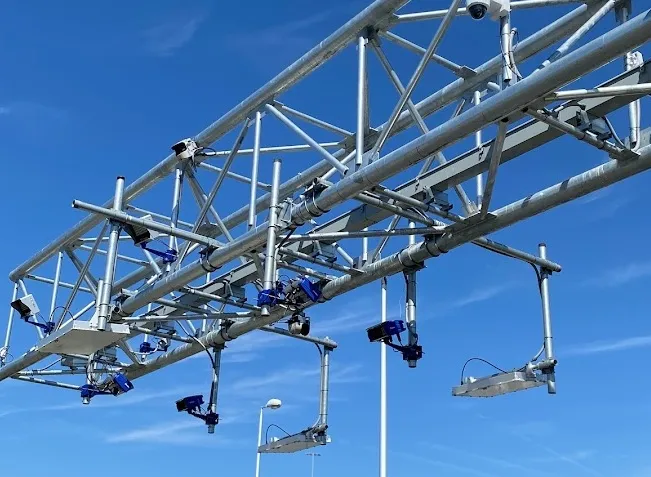
Kapsch told ITS International the contract covered the design and implementation of an open road tolling system for the Gauteng Province, a national transaction clearing house and violations processing centre.
For more information on companies in this article

Related Content

  • Emovis puts Elizabeth River Crossings free-flow toll into action
    February 7, 2025
    Old tolling system will be decommissioned after implementation in Virginia
  • SCATS study shows significant savings
    December 16, 2013
    Australian study quantifies the benefits of SCATS to the motorists, the environment and the economy. Opportunity weekday cost savings potential of some AUD16 million (US$15.2 million) has emerged from rigorous analysis of a one-day study of Australia’s Sydney Coordinated Adaptive Traffic System (SCATS) in operation. This represents 27% of the total cost of a real alternative semi-adaptive traffic control. The estimated indicative annual weekday-based value is AUD3,900 million (US$3,705 million) or 0.9% of t
  • Swedish drivers support speed cameras
    March 17, 2014
    In sharp contrast to many other countries drivers in Sweden support speed cameras and the planned expansion of the automated enforcement network. Sweden is embarking on a massive expansion of its speed camera network and is doing so with both a very high level of public acceptance and without its drivers feeling persecuted; a feat the administrations in many other countries would like to emulate. So how did this envious state of affairs come about? Magnus Ferlander director of business development and ma
  • Associations News around Europe
    April 30, 2015
    ERTICO ITS-Europe’s director of partnership services Rasmus Lindholm has met directors of Hungary’s National Mobile Payment scheme to explore opportunities for future cooperation. The event took place against the backdrop of the two organisations’ shared aim of putting ITS at the heart of the country’s Intermodal Transport Roadmap.




