
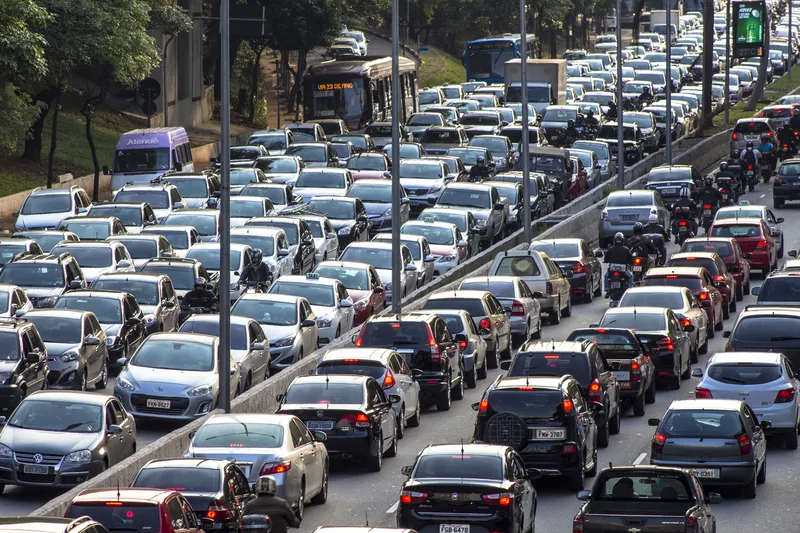
Ranked: the world's most congested cities

Inrix data suggests billions of hours are lost worldwide, hampering economies
By Mike Woof January 22, 2025 Read time: 2 mins
Good luck with that (© Alf Ribeiro | Dreamstime.com)

A new study from Inrix has revealed some of the world’s worst cities for traffic congestion. Inrix is a leader in transportation data and analytics and has released its 2024 Global Traffic Scorecard, which identifies and ranks congestion and commuting trends in nearly 1,000 cities, across 37 countries.

Istanbul’s 105 hours lost to congestion has topped the worldwide rankings, followed closely by New York City (102 hours) and Chicago (102 hours). The report shows that 10 US cities made the Top 25 worst congested cities in the world. Mexico City was ranked fourth, London fifth, Paris sixth, Jakarta seventh, Los Angeles eighth, Cape Town ninth and Brisbane 10th.

The high congestion levels in many US cities reflect a reduction in working from home, which increased during the Covid-19 pandemic. “Every year since 2020, we’ve seen traffic gradually rise towards what it was pre-pandemic,” said Bob Pishue, transportation analyst at Inrix and author of the 2024 Global Traffic Scorecard. 

“While the US is still behind pre-2020 levels of traffic, a pullback of remote and hybrid work models, specifically in tech-heavy areas like San Jose, San Francisco and Seattle, brought a large jump in downtown trips, which is a good sign for metropolitan economies. The data also shows more economic activity Saturday and Sunday evenings as the downtown core returns to life.”

The higher number of daily commuters heading downtown can bring economic benefits, but it’s a double-edged sword. Pishue continued: “Traffic can be an indicator of economic boon, but ironically, it’s a hamper on economies in of itself. Each minute spent waiting in traffic results in money and productivity lost.”

New York, Chicago (both with 102 hours) and Los Angeles (88 hours) are the most congested cities in in the US, costing drivers US$1,826 and $1,575 respectively. The country’s biggest increase in traffic congestion came from 15th-ranked Denver, where residents saw a 19% increase in traffic delay compared to 2023.

Overall, congestion resulted in drivers losing an average of 43 hours to traffic jams in 2024, equal to about one work week, costing $771 in lost time and productivity. Nationwide, this sums to more than four billion hours lost, costing $74 billion in lost time.

For more information on companies in this article

Related Content

  • Electric buses: more billion dollar orders
    August 3, 2015
    China will spend up to one trillion dollars on electric buses over the coming 15 years according to analysts IDTechEx. This will reduce the impact of over 22.5 trillion dollars from air pollution over that time, at least one percent of GDP. More insurrection will occur if corrective action is insufficient because hundreds of thousands are dying from traffic pollution and far more are suffering resultant serious disease. According to the World Health Organisation (WHO), outdoor air pollution caused 3.7 m
  • Ukraine turns to ITS to cope with traffic increases
    June 9, 2015
    With increasing road fatalities the Ukrainian government is planning to introduce ITS technology in 2016-2017. Eugene Gerden finds out more. The government of Ukraine is considering a massive introduction of ITS in the national system of traffic during the period 2016-2017, according to a recent statement by the Ukrainian Ministry of Transport. According to the Ukrainian government, implementation of the project is an acute need, as in recent years the number of road accidents in Ukraine has significantly
  • Wireless traffic management reduces costs and commute times
    January 30, 2012
    The County of Los Angeles is widely known for having among the worst traffic problems and the most road congestion in the US. To combat these problems, the Los Angeles County Department of Public Works decided to deploy a wireless communications system to connect over 1,000 of the most congested intersections so they could dynamically monitor and manage the congestion and reduce commute times.
  • Tunnel network to relieve Istanbul's traffic congestion
    August 14, 2012
    A series of road tunnels is taking shape to help relieve Istanbul from crippling road congestion, with an extensive array of safety and management systems operating from a single ITS platform. Nino Sehagic reports. Traffic in Istanbul has historically been described simply as jammed. Severe congestion and chaotic use of available road space are characteristics of a city of more than one and a half million cars. Istanbul’s existing road network could not cope and was in urgent need of expansion, leading the




