Intertraff deploys enforcement cameras in UAE

Emirate of Fujairah has taken 20 D-Cop 3 fixed speed camera units
By Adam Hill December 2, 2024 Read time: 2 mins
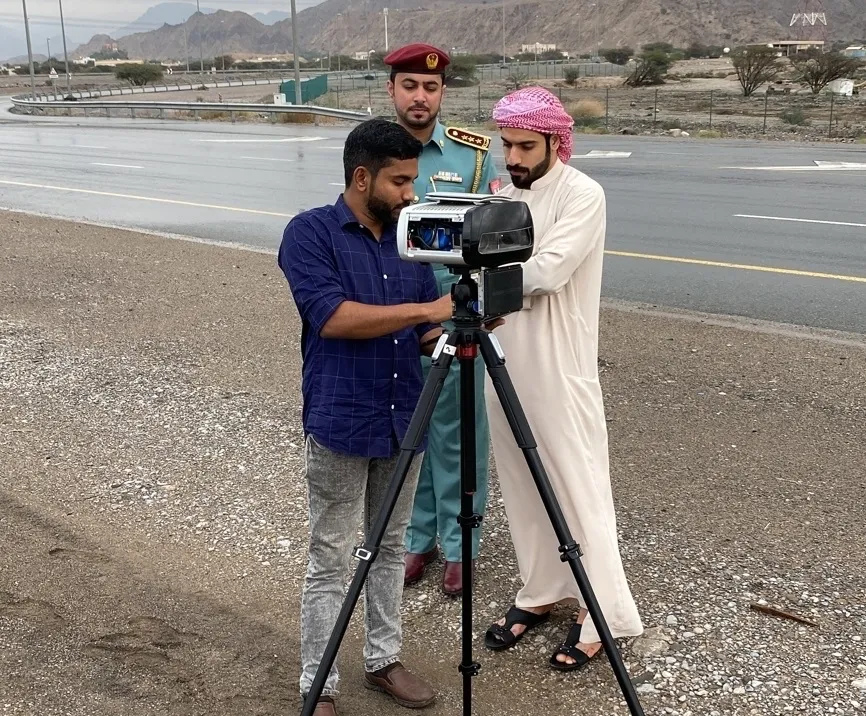
Since 2017, Intertraff's enforcement cameras—both fixed and mobile—have been installed across the UAE's northern emirates (image: Intertraff)

Intertraff has deployed speed enforcement cameras in Fujairah, one of the seven emirates which make up the United Arab Emirates.

"This project continues our strong collaboration with Inovexline, our trusted local partner in the UAE," says Toni Marzo, founder and CEO of Intertraff.

"For Fujairah, we installed 20 units of our D-Cop 3 fixed speed cameras. These systems efficiently monitor up to three lanes of traffic, offering a cost-effective alternative to our standard fixed cameras, which are capable of monitoring six or more lanes."

The Emirate of Fujairah's "technical expertise and deep understanding of cutting-edge traffic enforcement technologies ensure a rigorous evaluation process", explains Marzo. 

"Typically, they select providers through stringent proof-of-concept trials, often requiring our systems to perform side-by-side with competitors’ solutions at the same installation site. This comprehensive benchmarking ensures that only the best solutions are chosen."

Since 2017, Intertraff's enforcement cameras—both fixed and mobile—have been installed across the UAE's northern emirates. 

As well as enforcing speed regulations, the units address multiple traffic violations, including hard shoulder monitoring, tailgating detection, vehicle classification, with speed limits tailored to each class.

They also have capacity for low-speed enforcement, introduced in the UAE in April 2023, Marzo says.

"In addition to traffic enforcement, our cameras double as security tools by recording licence plates and performing vehicle make and model recognition for all passing vehicles," he adds. "Another key feature of our cameras is their low power consumption, making them ideal for remote installations. Many units in desert areas operate entirely on solar power, enabled by a standard solar panel set-up."

For more information on companies in this article

Related Content

  • Truvelo TRIMMS night-time speeds on unlit roads
    June 5, 2014
    Truvelo UK’s new TRIMMS infrared illumination enables mobile speed enforcement in the dead of night. Lincolnshire is the UK’s fourth-largest county, has a population of over a million and is predominantly rural. Only 66km of its 8,893km road network is dual carriageway and 79% of the rest is ‘C’ class or unclassified roads. In terms of Killed and Seriously Injured (KSI) figures, there were 415 casualties in 2013 (down from 526 in 2002). Official figures show inappropriate speed accounts for 25% of the UK’s
  • SCANaCAR and VideoBadge counter parking’s prickly problems.
    June 4, 2014
    Colin Sowman discovers how the latest systems can boost productivity and reduce conflict in parking enforcement. Parking enforcement is something of a ‘Cinderella’ service for local authorities: while necessary to keep the roads open and the traffic flowing, it is an expensive operation and can be loss-making. It is also labour intensive and parking enforcement officers are routinely verbally abused and sometimes physically attacked. Some authorities are now looking to automate parking enforcement in orde
  • Wireless traffic data in real time
    January 31, 2012
    The effect of moving objects on the electromagnetic landscape set up by cellular telephony networks can be detected and interpreted to give real-time traffic data across large geographical areas at low cost. Here, we revisit the Celldar concept. Global economic downturn has pushed public-sector agencies, transport administrations among them, to push even harder for cost efficiencies. Unfortunately, when it comes to transport safety and efficiency the public sector often has to work up to a cost rather than
  • Nokia builds comms network for the smart, super-connected highway
    March 6, 2025
    The challenges are clear, but operators are embracing digitalisation and automation as they work to transform the highway landscape