First look at brand new IRD product

Visitors to ITS America 2016 San Jose will be the first to see a new product from International Road Dynamics – the company’s very recently announced light-weight, cost-effective, portable UVAS under-vehicle surveillance system. The real-time UVAS system is designed to provide an affordable, robust and dependable under-vehicle inspection process for all vehicle check points in any terrain – day or night. Global weigh-in-motion technology specialist IRD says it provides the perfect solution to scan, inspect,
May 31, 2016 Read time: 2 mins

Visitors to ITS America 2016 San Jose will be the first to see a new product from 69 International Road Dynamics – the company’s very recently announced light-weight, cost-effective, portable UVAS under-vehicle surveillance system.

The real-time UVAS system is designed to provide an affordable, robust and dependable under-vehicle inspection process for all vehicle check points in any terrain – day or night.

Global weigh-in-motion technology specialist IRD says it provides the perfect solution to scan, inspect, and digitally record the underside of any road vehicle.

The UVAS system is mainly for 24/7 remote or temporary service applicable to checking for hidden explosives or other suspicious packages. The system produces a full-colour image of the entire underside within seconds of the vehicle passing over the scanning unit. Images are captured and displayed in real time on a high-definition display and stored for archive on a large-capacity hard drive.

The IRD package includes all the necessary components to set up a temporary vehicle check point. Mounted in a ruggedised fibre case, the main computer elements include a high-performance processor with a large-capacity hard disk drive. Attached to the hinged top is a 22” LCD display supporting resolutions up to 1920x1080. The case is mounted on heavy-duty casters and includes AC outlet plugs supporting operating voltages at 110-240VAC, 50-60Hz.

Included with the system are two separate cameras – one for the driver image / scene camera and the second one for LPR. The camera housing contains high-intensity LEDs with a high-speed scanning camera that is programmed to capture the undercarriage of a moving vehicle up to a speed of 30 km/h.

Images are instantly displayed and processed in real time for analysis.

For more information on companies in this article

Related Content

  • Teledyne e2v releases Emerald 5M image sensor
    November 28, 2018
    Teledyne e2v has launched its Emerald 5M CMOS image sensor which it says provides higher resolution images of objects in motion with no distortion. The solution is expected to be suitable for machine vision, automated optical inspection and factory automation applications. Emerald 5M features a global shutter and MIPI CSI-2 interface which allows it to utilise image signal processors available for mobile applications. According to Teledyne e2v, the sensor comes with digital functionalities such as subsa
  • Rapid deployment ANPR
    February 6, 2012
    NDI Recognition Systems has launched the ST200, a new rapid deployment Automatic Number Plate Recognition (ANPR) system designed for use in a wide range of covert and overt applications in both mobile and static modes.
  • IRD announces strong third quarter, launches new products
    October 14, 2016
    Intelligent transportation systems provider International Road Dynamics (IRD) has announced solid financial results for the third quarter of 2016, with revenues up 16.0 per cent to US$36.6 million (CA$48.4 million) on growth in key North American markets and an increase in gross margin to 32.5 per cent. Nett earnings increased 27.5 per cent to US$1.6 million (CA$2.2 million). The company says it is in a strong financial position with working capital of US$10 million ($13.3 million). According to Terry Be
  • Theia develops innovative distortion-free ultra-wide-angle lenses
    October 26, 2022
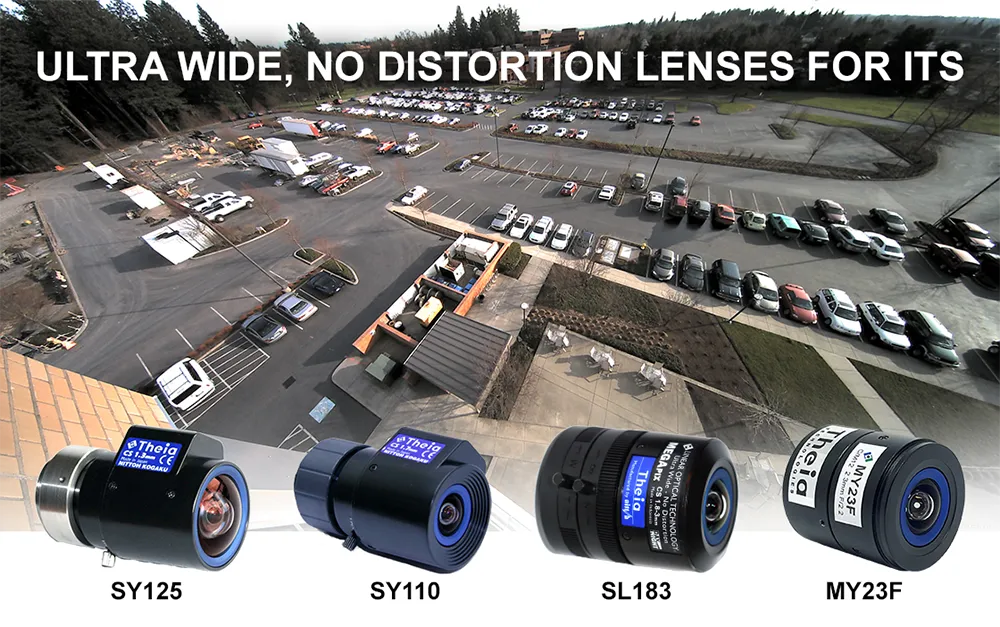
    Today’s high-resolution cameras have many advantages if they have the right lens for the job. When that includes covering large areas or reducing cost by installing fewer cameras, you need a wide-angle lens. Fisheye style lenses with barrel distortion are routinely used to cover an ultra-wide field of view; however, they create a curved and distorted image which causes significant loss of resolution at the image edges. This presents a variety of issues for ITS applications such as difficulty in identification or recognition of objects and details.