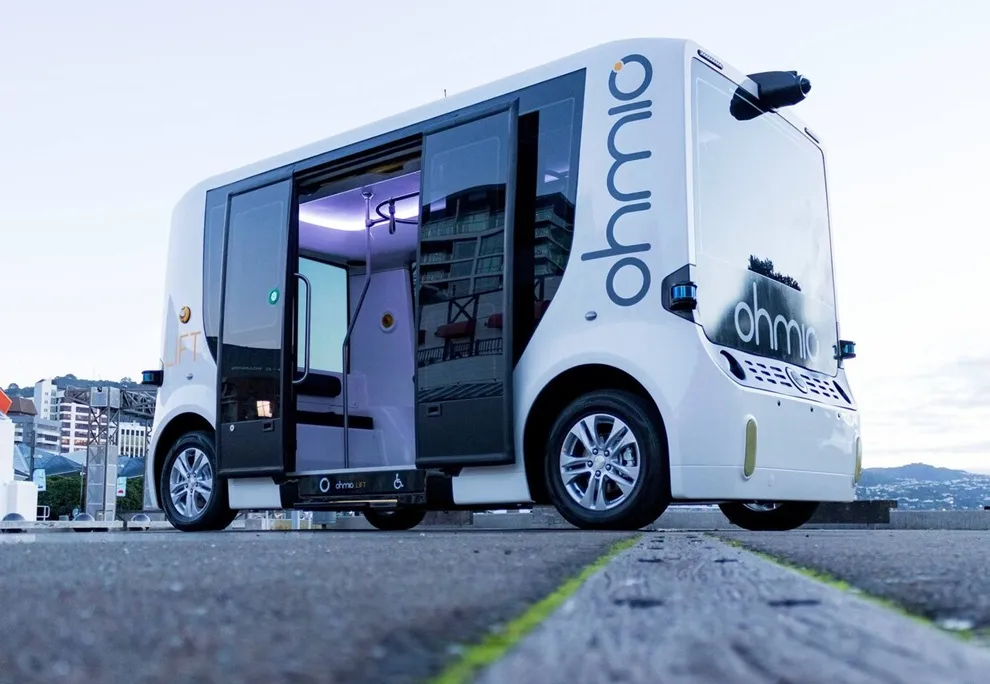
2getthere’s Group Rapid Transit vehicle passes desert climate test

2getthere’s Group Rapid Tansit (GRT) autonomous vehicle has proven in a simulated desert climate that it can maintain an indoor temperature of 23˚C even in the worst scenario (52˚C outside temperature and 3% humidity). The climate test took place in the Utrecht province and is one of many tests regarding the mega-order received from United Arab Emirates earlier this year. From 2020, five vehicles will perform fully autonomous shuttle services to and from Bluewater Island in Dubai.
October 26, 2017 Read time: 2 mins

8172 2getthere’s Group Rapid Tansit (GRT) autonomous vehicle has proven in a simulated desert climate that it can maintain an indoor temperature of 23˚C even in the worst scenario (52˚C outside temperature and 3% humidity). The climate test took place in the Utrecht province and is one of many tests regarding the mega-order received from United Arab Emirates earlier this year. From 2020, five vehicles will perform fully autonomous shuttle services to and from Bluewater Island in Dubai.

GRT was subject to three tests in weather conditions such as ‘hot dry’ and ‘hot humid’ with a focus on the performance of the air conditioning system (ACS) at the vehicles maximum capacity of 24 passengers.

13 ACS has been developed in collaboration with suppliers DC Airco and Netherlands Aerospace Centre (NLR) who used the simulation of heat management in relation to airflow within the vehicle in its design of the air conditioning. Its development has been partly financed through a 2024 Massachusetts Institute of Technology research grant in which DC Airco and 2getthere have both participated.

The simulated weather conditions included extremely high temperatures and sun radiation with average peaks in the sun radiation of 1,040 Watts per square metre and peaks in temperature of 52˚C around 3.30pm. In the climatic chamber, both peaks were simulated at the same time.

The GRT’s 16 standing passengers represented 120 Watts each and eight seated passengers each represented 100 Watts were simulated by placing a 3000-Watt heat source inside the vehicle. Part of the test focused on performance during transition: the speed at which indoor conditions are brought back to the most comfortable level for passengers after the doors close and the vehicle starts its journey. The most extreme test was based on the vehicle standing still with the doors open for six minutes, but in actual circumstances much shorter stops will be sufficient to allow 24 passengers to enter the vehicle and find their seats.

According to 2getthere the test marks another step towards the operational deployment of the system, scheduled for 2019/2020.

For more information on companies in this article

Related Content

  • Replace short car trips with e-bikes: report
    May 23, 2022
    Relatively small changes of mode would have big knock-ons in CO2 savings, says Bike Adviser
  • Important additions to AVT’s Manta and Prosilica ranges
    November 23, 2012
    Allied Vision Technologies (AVT) has announced important new additions to its Manta and Prosilica camera ranges. The Manta G-917 GigE Vision, which will be available later this year, is claimed to be the world’s first machine vision camera with a new 9-Megapixel sensor. This new 1“ sensor chip has 3384 x 2710 pixels resolution and delivers over 10 fps, offering excellent image quality, reduced smear, high quantum efficiency and increased NIR sensitivity. AVT says that with its high resolution approach pac
  • Ohmio opens California HQ
    March 11, 2025
    New Zealand-based autonomous shuttle provider targets US market
  • Siemens enhances loop detector
    July 25, 2013
    Siemens has enhanced the functionality of its SLD4 loop detector which now features length-based classification with configurable outputs which can be set to activate when specific conditions are detected, such as large vehicles exceeding a predefined speed. The detectors offer standard vehicle detection and are also suitable for use in bus, tram and light rail transport (LRT) schemes and other applications where high detection accuracy is required. Designed for maximum reliability and using the latest ind