
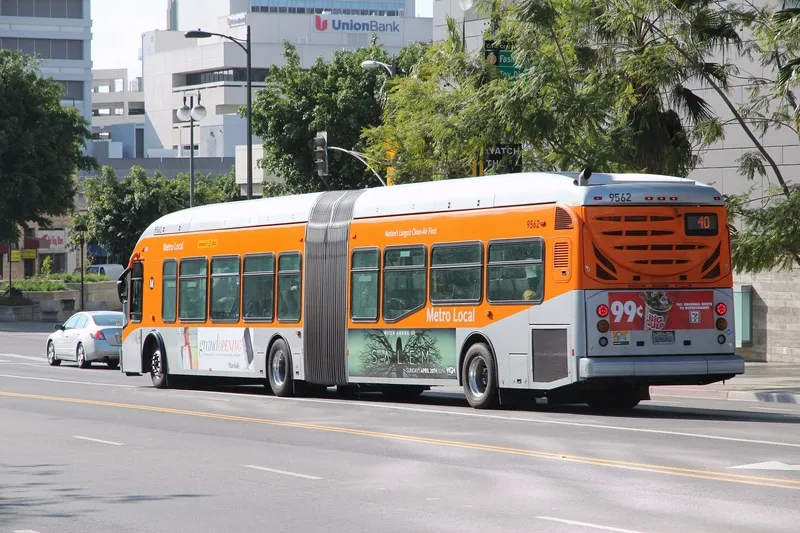
LA Metro seeks to attract more bus riders

Transport authorities in Los Angeles are trying to attract more people to bus services in a bid to halt falling ridership and entice drivers out of their cars.
By Ben Spencer January 17, 2020 Read time: 2 mins
ID 153990287 © Tupungato | Dreamstime.comv

A report in the Los Angeles Times says that LA Metro officials have come up with plans for more frequent services on more routes, amounting to the “first overhaul of the region’s bus network in more than 25 years”. 

Greater speed and efficiency is the aim of the new blueprint: buses would arrive as often as every five minutes on 29 major routes. This means that 83% of Metro passengers could walk to a stop – whereas at present only 48% can do that, according to LA Metro officials.

Investment of $1 billion over five years is also on the agenda, including $750 million for bus lanes and smarter signalling, with $150 million for shelters and improvements at popular stops.

The report suggests that ridership – which has dropped nearly 25% over a decade - could be improved by 15-20% if the changes are carried out.
However, there will be no extra buses on the street – instead, existing services would be reallocated.

The changes are to be discussed next week, with public meetings beginning in February and a final decision expected in September.

LA mayor Eric Garcetti says it would mean the city is going “in the right direction, toward dedicated bus lanes, higher ridership, and faster, more reliable service”.

For more information on companies in this article

Related Content

  • Gearing up for IntelliDrive cooperative traffic management
    February 1, 2012
    Beginning in the first quarter of 2010 it became evident that the IntelliDrivesm programme direction had been reestablished, by the USDOT's ITS Joint Program Office (JPO), after being adrift for a few years. The programme was now moving toward a deployment future and with a much broader stakeholder involvement than it had exhibited previously. By today not only is it evident that the programme was reestablished with a renewed emphasis on deployment, it is also apparent that it is moving along at a faster pa
  • Manchester seeks smart but not selective transport solutions
    January 25, 2018
    Smarter transport relies on better communications both with travellers and between transport providers. Andrew Williams reports. Inrix’s prediction that the cost of traffic congestion will rise by 63% to £21bn per year by 2030 clearly illustrates that, in addition to the ongoing inconvenience and inefficiency, ongoing gridlock is a significant drain on the economy. It is against this backdrop that a Cisco-led consortium has launched CitySpire, a smart transport programme that uses location-based services a
  • Manchester seeks smart but not selective transport solutions
    January 25, 2018
    Smarter transport relies on better communications both with travellers and between transport providers. Andrew Williams reports. Inrix’s prediction that the cost of traffic congestion will rise by 63% to £21bn per year by 2030 clearly illustrates that, in addition to the ongoing inconvenience and inefficiency, ongoing gridlock is a significant drain on the economy. It is against this backdrop that a Cisco-led consortium has launched CitySpire, a smart transport programme that uses location-based services a
  • Melbourne buses to get bus tracking system
    March 31, 2014
    Public Transport Victoria (PTV) in Australia has opted for Smartrak as the preferred supplier to operate the bus tracking system (BTS) for metropolitan buses. PTV chief executive officer Mark Wild said that the award of this contract is another step forward in providing better and real-time information, as well as improved bus services for our customers. It also paves the way for the provision of real time bus tracking information via smartphone apps, online and PTV’s customer contact centre. The new




