
Commsignia expands V2X messaging 

Information aggregated from multiple sources with the use of 4G and 5G connections
By Ben Spencer March 29, 2021 Read time: 2 mins
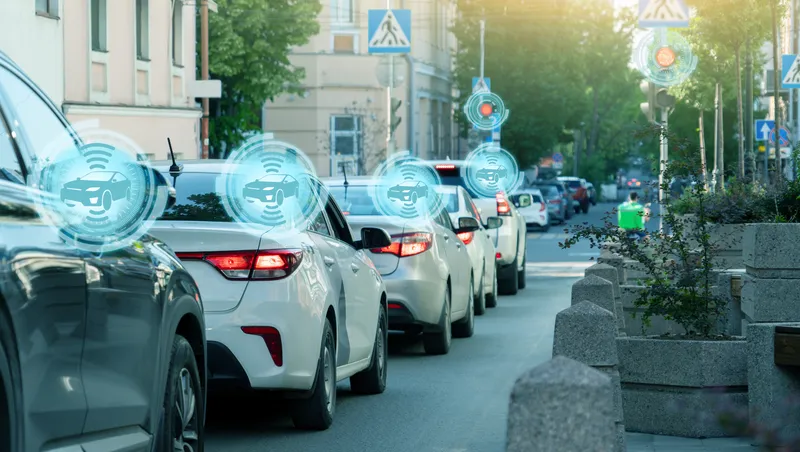
Commsignia’s hybrid fusion layer verifies alerts from different sources and provides the driver with aggregated data (© Scharfsinn86 | Dreamstime.com)

Commsignia has developed a method of transmitting automotive-grade Vehicle to Everything (V2X) messages, including information aggregated from multiple sources with the use of 4G and 5G connections.

The company says its Vehicle to Network (V2N) solution can be applied to avoid traffic jams and prevent accidents in semi-static situations, such as when cars congest highway exits and obstruct the outer lane, creating a dangerous situation. 

One known solution is when the on-board navigation system of stalled vehicles sends status information to the cloud via a 4G or 5G cellular connection.

The navigation supplier’s cloud-based traffic information service then informs other vehicles of a possible traffic jam in the area, but Commsignia insists such solutions usually only work within the specific supplier’s ecosystem.

Commsignia's system is expected to aggregate information from different data sources, including various suppliers’ cloud databases, infrastructure data from roadside sensors and cameras, and sensor data from V2X enabled vehicles.

The company points out that while cloud-based solutions trigger an early warning about a possible event, a vehicle’s V2X on-board unit sends more precise information in low-latency direct messages to other V2X-enabled vehicles in the area.

According to Commsignia, these Vehicle to Vehicle (V2V) messages contain the exact location of the recognised event. 

Commsignia’s hybrid fusion layer verifies alerts from different sources and provides the driver with aggregated data.

The company claims its solution offers more precise warnings and opens up the possibility of notifications reaching more drivers by combining network-based V2N, infrastructure-based Vehicle to Infrastructure and vehicle-based V2V data. 

András Váradi, research director at Commsignia, says: “One of the big challenges in digital traffic safety is reaching most drivers, and it makes sense to combine multiple channels such as direct V2X communications and the 4G or 5G cellular networks. The aggregation and verification of different information sources offer a robust and reliable messaging solution, all based on automotive grade V2X standards.”



 

For more information on companies in this article

Related Content

  • Workzone safety can be economically viable
    October 24, 2014
    David Crawford looks how workzone safety can be ‘economically viable’. Highway maintenance is one of the most dangerous construction industry occupations in Europe. Research from The Netherlands on fatal crashes indicates that the risk facing road workzone operatives is ‘significantly higher’ than that for the general construction workforce. A survey carried out by the Highways Agency, which runs the UK’s motorway and trunk road network, has suggested that 20% of road workers have suffered injuries from pa
  • Kapsch TrafficCom: 'The city is not made for cars'
    October 22, 2018
    Traffic can be a really big challenge. When you’re stuck, you’re stuck. Everything comes to a standstill. But Alexander Lewald describes how existing infrastructures can be used more efficiently and how demand can be managed. A few figures to start with: in Los Angeles, the average driver spends 102 hours a year in traffic – that’s more than four days. This figure is 91 hours in Moscow and New York, 74 in London, 69 in Paris, 51 hours in Munich and still 40 hours in Vienna. Traffic is what causes
  • Can AV mapping rely on crowds?
    June 29, 2021
    Mapping tech companies need to expand their data inputs beyond crowdsourcing in order to maintain temporally accurate maps at scale, says Ro Gupta at Carmera
  • Healthy prospects for floating vehicle data systems
    February 3, 2012
    Elmar Brockfeld, Alexander Sohr and Peter Wagner from the German Aerospace Center's Institute of Transport Systems look at the prospects for floating vehicle data systems. Although Floating Vehicle Data (FVD) or probe vehicle fleets have been around for about a decade, the idea behind them is of course much older: from probe vehicles that flow with the traffic it should be possible to get a precise, fast and spatially near-complete picture of the prevailing traffic flow conditions in an area under surveilla




