Peachtree offers mobility research vehicle 

Test vehicle utilises VaaS cameras and intelligent traffic signals
By Ben Spencer February 16, 2021 Read time: 2 mins
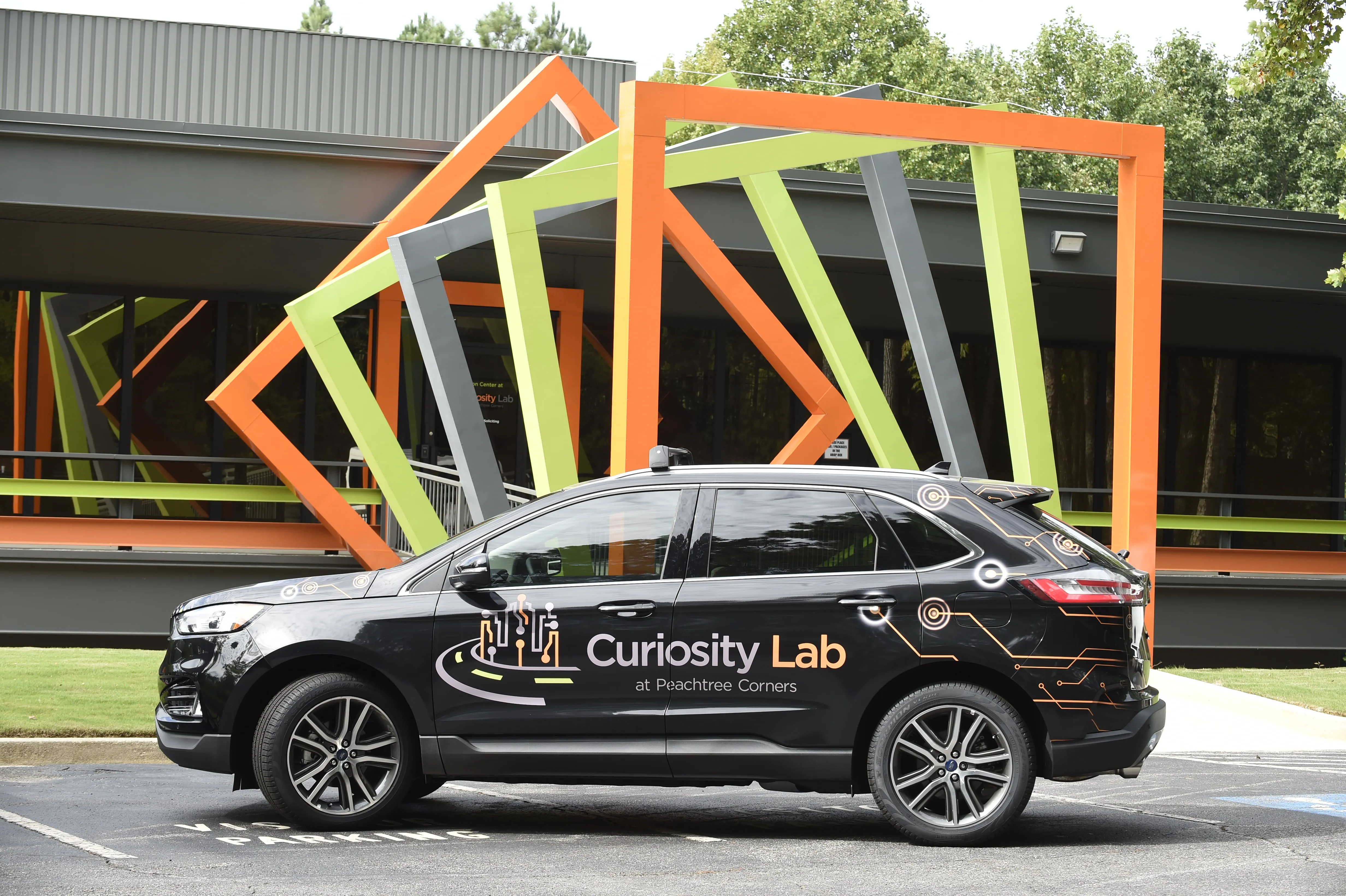
Peachtree says the vehicle was chosen due to easy developer access to historical AV datasets (© City of Peachtree Corners)

Peachtree Corners in the US state of Georgia has unveiled a test vehicle to help companies develop mobility and autonomous technologies in a living laboratory environment.

Curiosity Lab at Peachtree Corners offers a real-world living laboratory environment where the test vehicle interacts with local residents. It includes a public street that is insured for both driven and autonomous vehicle (AV) activity.

Peachtree Corners says the Ford Edge-based test vehicle is equipped with Level 3 autonomous capabilities on an open-source platform.

Brandon Branham, assistant city manager of Peachtree Corners, says: “Companies have the opportunity to develop new technologies on an open source mobility platform alongside other emerging solutions, while also leveraging actual smart infrastructure wholly owned by the city – not proprietary, closed platforms in closed track environments."

"The Ford Edge based test platform here operates in a living lab environment alongside residents that are walking and driving on the same public street.”

The city choose the Ford Edge platform due to easy developer access to historical AV datasets. 

The test vehicle utilises a range of systems, including Bosch Video as a Sensor (VaaS) cameras, intelligent traffic signals, dedicated short-range communication units and next-generation cellular. 

It is also equipped with a large rooftop rack, allowing companies to attach their own Lidar and other sensors for testing.

Data from the sensors and devices on the test vehicle as well as across the city infrastructure is analysed and made available to engineers through the city's central control room. 

Curiosity Labs is inviting companies working on full autonomous driving systems, mapping, Lidar, camera and computer vision, radar and Vehicle to Everything systems to test. 

 

For more information on companies in this article

Related Content

  • CES 2023: Seoul Robotics releases SENSR 3.0
    January 5, 2023
    3D perception platform is used in ITS applications to boost traffic flow and road safety
  • Infrastructure and the autonomous vehicle
    December 12, 2014
    Harold Worrall ponders the effect of autonomous vehicles on transportation infrastructure. For the last century the transportation industry has been focused on the supply of infrastructure to support the ever growing fleet of vehicles and the greater number of miles covered by each vehicle. Our focus has been planning, funding, designing, building and maintaining roadways. Politicians, engineers, planners, financial managers … all of us have had this focus. We have experienced demand growth since the first
  • Charlottesville signals its integration with Econolite
    January 23, 2025
    Small Virginia city has big plans for traffic management with Centracs
  • Transportation applications move to machine vision’s mainstream
    June 11, 2015
    The adaptation of machine vision to transport applications continues apace. That the machine vision industry is taking traffic installations seriously is evident by the amount of hardware and software products tailor-made for ITS applications that are now available on the market. A good example comes from US-based Gridsmart Technologies which has developed a single wire fisheye camera that provides a horizon to horizon view for use at intersections. Not only does the single camera replace four or more in a