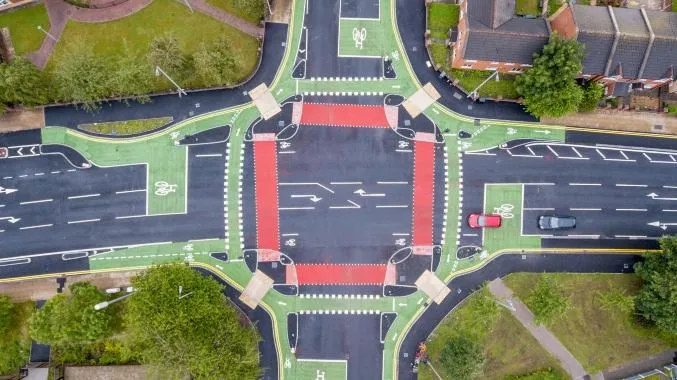
Wavetronix ‘in the box’ detection ensures cycle safety at intersections

Wavetronix is to carry out what it calls a first-of-its-kind installation of its SmartSensor Matrix in the city of Tustin, California for the Tustin Ranch Road Extension project. As part of the project, the city is incorporating cycle detection technology and is using Wavetronix radar in a unique ‘in-the-box detection designed to ensure that cyclists can safely pass through signal-controlled intersections before the light changes to red. SmartSensor Matrix is able to detect cycles and register them
February 5, 2014 Read time: 2 mins
148 Wavetronix is to carry out what it calls a First-of-its-kind installation of its SmartSensor Matrix in the city of Tustin, California for the Tustin Ranch Road Extension project.

As part of the project, the city is incorporating cycle detection technology and is using Wavetronix radar in a unique ‘in-the-box detection designed to ensure that cyclists can safely pass through signal-controlled intersections before the light changes to red.

SmartSensor Matrix is able to detect cycles and register them as part of traffic, eliminating the problem that traffic cameras often cannot detect cycles; and inductive loops require cycles to be positioned in a specific location above the loop for accurate detection.  Matrix, which generates 16 separate radar beams, can detect cycles in user-defined zones anywhere in its 90-degree, 140-foot field of view.  As a result, cycles are treated like any other vehicle when it comes to activating signals.

Working with Wavetronix and SummitCrest, Wavetronix’ local partner, project consultants Hartzog and Crabill created the ‘in-the-box’ detection configuration to both detect traffic at the stop bar and track cycles through the intersection, or ‘inside the box’. The system is initially being rolled out at four intersections.

For more information on companies in this article

Related Content

  • Smartphones smooth the journey for visually impaired
    May 13, 2016
    Moves to make life easier and safer for vulnerable and impaired road users are gaining strength on both sides of the Atlantic. A recent webcast by the US Roadway Safety Institute, based at the University of Minnesota, showcased work in progress on a positioning and mapping methodology using Bluetooth and smartphone technologies to support situation awareness and wayfinding for the visually impaired.
  • Improving traffic flow with the SignalGuru app
    September 19, 2012
    Researchers at the Massachusetts Institute of Technology have developed SignalGuru, an app that uses dashboard-mounted smartphones to help drivers avoid red lights and reduce fuel consumption. Researchers say that SignalGuru predicts when a traffic signal is about to change, and the speed that should be driven when approaching an intersection in order to cruise through without stopping.
  • P3s offer new options for public transit agencies
    March 28, 2018
    David Crawford welcomes new US guidance on public-private partnerships in the public transit sector. Public-private partnerships (P3s) are becoming increasingly favoured as a means of cost-effectively delivering much-needed public transit projects across the US. Previously, researched examples have tended to be on the large-scale while information on the potential for smaller, more localised schemes has been comparatively sparse. In a bid to fill that gap, the ‘Public Transportation Guidebook for Small
  • Manchester focuses on Cyclops junction
    July 13, 2020
    Northern English city has its eye on a better cycling experience