
Swarco sets up live-lane running on Germany's A8

System spans 2.8km along hard shoulder of motorway between Karlsruhe and Karlsbad
By David Arminas March 7, 2023 Read time: 2 mins
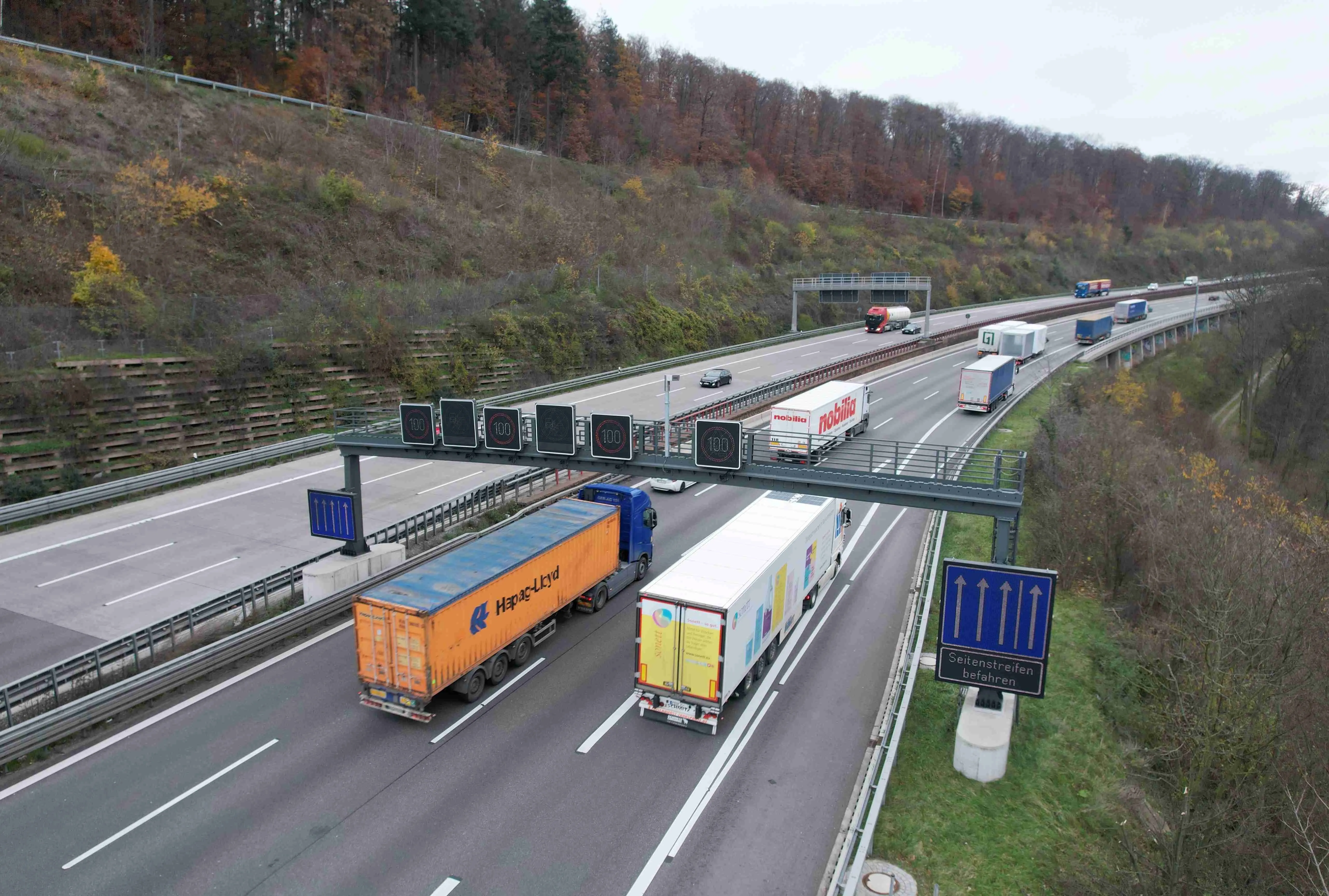
The set-up consists of four display cross-sections with LED variable VMS, eight pole installations for VMS or camera technology as well as 12 route stations (image: Autobahn GmbH Niederlassung Südwest)

Swarco has installed a temporary hard shoulder clearance, or live-lane running system, on the A8 motorway in southwest Germany for the Die Autobahn highways agency.

The A8 is an important central east-west link in the European transport network. The section between Karlsruhe motorway interchange and Karlsbad junction features a winding route and gradients of around 7.5% and is highly congested with about 110,000 vehicles per day. Traffic flow is often blocked in this section due to slow-moving trucks and there are frequently overtaking manoeuvres and lane changes taking place.

Swarco's system spans 2.8km along the motorway between Karlsruhe and Karlsbad. It consists of four display cross-sections with LED variable message signs (VMS), eight pole installations for VMS or camera technology as well as 12 route stations. In addition to the outdoor equipment, Swarco also provides central control software.

The camera technology is from Fuunkwerke Video Systeme while the operation of all functions is managed by the Autobahn traffic control centre in Stuttgart. Before the hard shoulder lane becomes a live lane, it must be checked by the traffic control centre to ensure that no obstacles are blocking the lane.

Swarco says that the system offers a climate- and resource-friendly possibility for using existing infrastructure more effectively without the need for costly and more permanent expansion of that infrastructure. In fact, notes Swarco, the capacity of the infrastructure can increase up to 30% with such a system.

The first live-lane running took place early last December.

The introduction of live-lane usage on hard shoulders has been controversial among highway safety experts and the public. Early last year, the UK stopped implementation of its so-called smart motorway schemes until safety data has been collected over five years, according to the Department for Transport.

The department said that during this time it will invest €1.08 billion (£900 million) to improve safety on existing All-lane running motorways. The roll-out of new smart motorways will be paused for schemes introduced before 2020. After this five-year period, the government will assess the data and make an informed decision on next steps, it said.

Although available data shows smart motorways are comparatively the safest roads in the country in terms of fatality rates, the government says it "will go further by ensuring current smart motorways without a permanent hard shoulder are equipped with best-in-class technology and resources to make them as safe as possible”.

For more information on companies in this article

Related Content

  • Tecsidel’s Pan-American Highway tunnel eases Lima’s traffic woes
    December 4, 2018
    The Pan-American Highway connects the US and Canada with Latin America, running for thousands of miles from Alaska in the north to Argentina in the south. Mauro Nogarin finds that one tunnel built underneath it is now providing relief for thousands of travellers each day On the Pan-American Highway, the lengthy series of roads which spans both American continents - from the US state of Alaska to the Latin American country of Argentina - ITS solutions are many and varied. One of these, in Peru’s capital
  • European tunnel safety steps up a gear
    September 19, 2017
    David Crawford reviews the latest safety systems installed in European tunnels. Blueprints for the safer road tunnels of the future are emerging fast as European operators invest in technologies to enhance travellers’ prospects of surviving an accident. Central to modern emergency planning is the principle that, following an incident, drivers should be enabled to rescue themselves and their passengers with the aid of prompt and correct identification and communication of the hazard. Roles for cooperativ
  • Road user charging potential solution to transportation problems
    December 14, 2012
    A number of new and highly significant open road tolling schemes have just been launched or are soon to ‘go live’. Systems of road user charging are flexing their muscles as the means to solve politically sensitive transportation problems, reports Jon Masters. Gothenburg, January 2013, will be the time and place for the launch of the next city congestion charging scheme in Europe. In a separate development, Los Angeles County’s tolled Metro ExpressLanes began operating in November 2012 – the latest in a ser
  • Enforcement suppliers highlight industry best practice
    March 15, 2012
    Major suppliers of enforcement technology highlight the countries, regions or cities that they consider to be leading the way in reduction of road traffic violations. The French government’s ambitious programme of enforcing traffic law violations has proven to be an unrivalled success and is continuing to bring improvements in road safety with innovative enforcement technology.




