European public mobility business ViaVan has launched a fully electric, on-demand shared ride service in Oberhausen, Germany.
ViaVan says that the new service - in partnership with public transport authority Stoag (Stadtwerke Oberhausen) - fills the gaps during evening hours when public transit is less available.
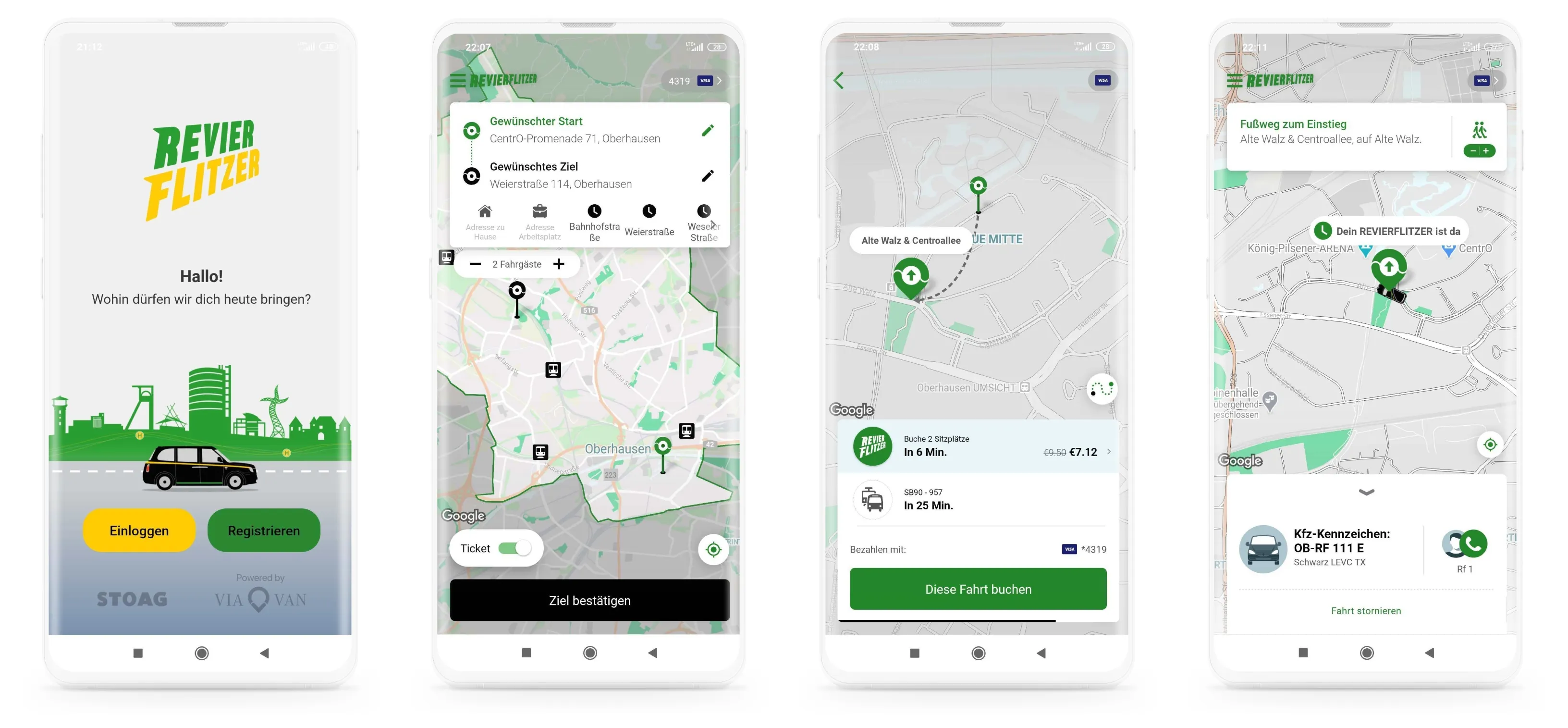
The Revierflitzer service complements and extends the existing public transit network and is booked through a mobile app - on which Stoag and ViaVan collaborated - and all vehicles are wheelchair accessible.
Users will select a pick-up and drop-off location within the service zone and confirm their ride.
Once a ride is booked, ViaVan’s technology matches multiple passengers headed in the same direction into a single vehicle.
By routing vehicles in real-time, ViaVan says it is able to minimise detours which reduces miles travelled while providing a highly efficient service.
As social distancing measures are still in place at the launch of the service, a maximum of three out of six seats will be available to book.
Drivers will be separated from passengers with a window pane, explained Sabine Lauxen, Oberhausen’s head of environmental affairs.
“Technology-enabled solutions like the Revierflitzer have the power to provide safe, efficient and sustainable access to public transportation, while complementing and extending existing transit infrastructure,” said Chris Snyder, chief executive of ViaVan.
ViaVan was founded in 2017 as a joint venture between Via, a developer of on-demand public mobility, and Mercedes-Benz Vans. The companies are also collaborating on the development of sensor technology, electric vehicle fleet management and autonomous driving.
ViaVan powers mobility services across Germany, including the BerlKönig in Berlin and BerlKönig B/C in Brandenberg, both with Berliner Verkehrsbetriebe (BVG), as well as services in Bielefeld with moBiel and Lübeck with SVHL. ViaVan also powers corporate mobility services for BASF and Daimler.