
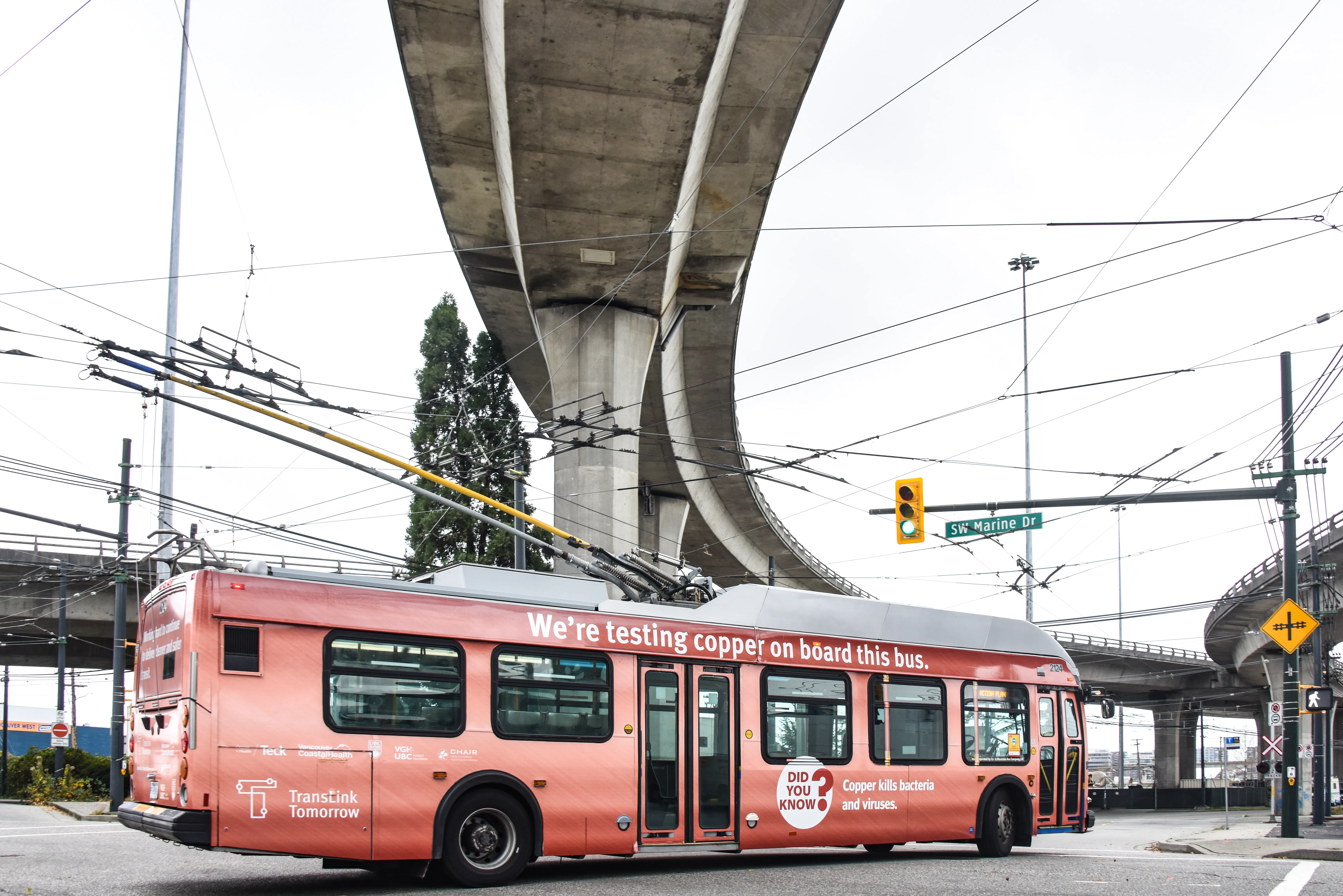
TransLink trials 'virus-killing' copper on transit

Vancouver transport network's four-week trial aimed at improving Covid hygiene
By Ben Spencer November 27, 2020 Read time: 2 mins
TransLink’s project is part of a study in which copper-based products and organosilane will be installed on SkyTrain and buses (© TransLink)

Metro Vancouver's public transport agency TransLink is using copper as a cleaning agent on high-touch surfaces in a bid to make public transit safer during the coronavirus pandemic.

The project is part of a study in which various copper-based products and a protective coating called organosilane will be installed on light rapid transit system SkyTrain and buses to test how effective these agents are at destroying viruses and bacteria on public transport.

Organosilane is a wipe-on coating that provides protection against microbes such as bacteria, mould and mildew. 

TransLink says using copper and Organosilane in tandem with hygiene and cleaning protocols can help inhibit the build-up and growth of viruses and bacteria. 

During a four-week pilot phase, the products will be installed on two SkyTrain cars on the Expo and Millennium Lines, which both connect cities such as Vancouver and Burnaby. 

Additionally, surfaces will be swabbed twice a week and tested to determine antimicrobial effectiveness.

At the end of the month, the surfaces will also be assessed for durability.

“The risk of Covid-19 transmission on transit remains extremely low and this initiative will only bolster our comprehensive cleaning protocols which are already in place," TransLink CEO Kevin Desmond says.

"Any findings from this pilot project will be shared with our fellow transit agency colleagues and other industries which may be able to use this emerging technology.”

Teck Resources is funding the initial phase of the project as part of a copper and health programme. 

It follows studies conducted at Vancouver Coastal Health showing that copper is effective at killing bacteria.

Dr. Marthe Charles, medical microbiologist at Vancouver Coastal Health, says: “This project builds on preceding research and will increase our understanding of the effectiveness of copper in killing organisms on frequently-touched surfaces. Positive findings will then be used to study the impact of copper on bacteria and viruses such as Covid-19 and norovirus.”

Other partners include VGH & UBC Hospital Foundation, CHAIR (Coalition for Healthcare Acquired Infection Reduction) and the University of British Columbia.

For more information on companies in this article

Related Content

  • Distraction dominated teen driver accident causes.
    June 3, 2015
    As a new report shows that distracted driving is a bigger cause of accidents than previously thought, Jon Masters asks what should be done to counter this problem. Research carried out by the AAA Foundation for Traffic Safety has shed new light on the dangers of distraction for teen drivers. Six years of study using video analysis has shown that 58% of all crashes involving teen drivers are caused by the driver being distracted and proved that the influence of external factors is stronger than previously th
  • Colas to trial and develop autonomous IPV
    April 20, 2016
    UK company Colas will begin building and trialling the first autonomous impact protection vehicle (IPV) in the UK this year in partnership with two US companies, Royal Truck and Equipment and Micro Systems. Fitted with an electro-mechanical system and fully integrated sensor suite, the autonomous IPV has a leader/follower capability that allows it to follow a lead vehicle, unmanned. GPS position data is transmitted from the leader vehicle to the follower vehicle, which uses the data to follow the exact p
  • Oxa & Beep deliver AV services in Florida
    February 29, 2024
    Shuttles are part of Ultimate Urban Circulator Project which includes monorail expansion
  • Mitsubishi consortium receives letter of conditional acceptance for Doha Metro
    February 23, 2015
    A consortium of Mitsubishi Heavy Industries, Mitsubishi Corporation; Hitachi, The Kinki Sharyo and Thales has received a Letter of Conditional Acceptance from the Qatar Railways Company (Qatar Rail) for a systems package for the Doha Metro, the first metro system to be constructed in the State of Qatar. It is said to be one of the world’s largest projects for a single metro system. Construction is scheduled for completion by October 2019. Qatar Rail is the owner and manager of Qatar’s rail network and respo




