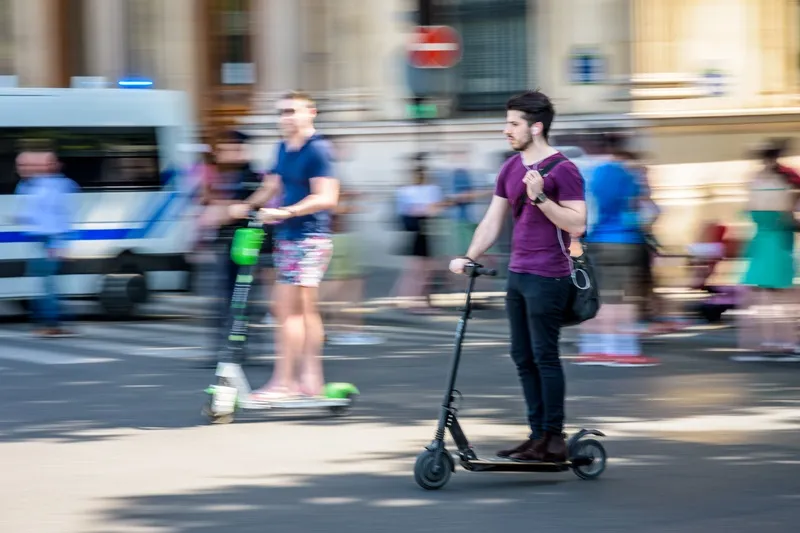
Trials of rental e-scooters are due to begin this week in the UK following changes to government guidelines.
Local authorities can allow or run 12-month rental schemes in a bid to understand their effect on other traffic, and on safety for users and others.
They can be ridden on roads, cycle lanes and tracks - but are strictly prohibited on pavements.
Speed is limited to 15.5mph - but the government has stopped short of making helmets mandatory; instead, riders are "recommended" to wear them.
Users will need a full or provisional car, motorcycle or moped licence to take part in the trials, and must be 16 or over.
Individually-owned scooters will still be illegal on public roads in the UK.
Transport minister Rachel Maclean said: "E-scooters may offer the potential for convenient, clean and cost-effective travel that may also help ease the burden on the transport network, provide another green alternative to get around and allow for social distancing. The trials will allow us to test whether they do these things."
Companies have welcomed the move.
“Public transport use is still at a record low of 10-16% according to UK government data, while private car trips have more than doubled since the start of the lockdown, sitting at 77% of normal levels," says Sandra Witzel from SkedGo.
“To prevent a backslide towards increased carbon emissions and poor air quality, it’s crucial trials for e-scooters show the public how micromobility can form an essential part of their commute and daily transport during the recovery period."
She added: “Disruption is the mother of change, and now is the time for local authorities to capitalise on our newfound love for alternative forms of transport. If they can demonstrate that e-scooters are cheaper, greener and faster than private cars, they can shape new behaviours and carve out more space for environmentally friendly travel in our cities.
Felix Petersen, Spin's head of Europe, is 'thrilled' that the UK is trialling e-scooters, saying: "Micromobility delivers a convenient, clean and cost-effective travel choice instead of buying a car or using ride-hailing services that increase congestion and pollution. In the US, we have seen our own ridership bounce back faster than public transit, competing with both walking and driving."
He pointed to the French cities of Paris and Marseille, which are adopting regulatory frameworks "that bring certainty to the e-scooter marketplace".
"We believe the most successful programmes will continue to impose requirements that make for a more sustainable future for micromobility, including requiring operators to scale fleets to meet demand, introducing fleet caps to avoid oversaturation and chaos seen in other cities, and rewarding operators for their compliance."