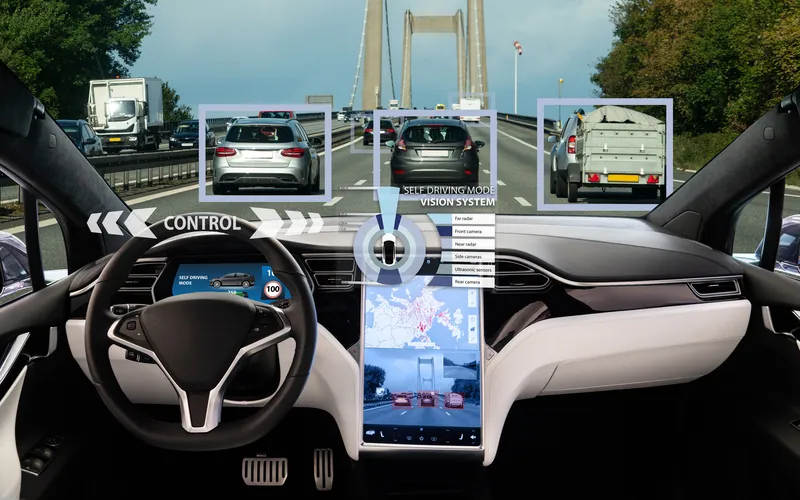
Google and various automakers have increased their activity and investments toward the goal of self-driving vehicles, while Google has shifted from its previous strategy to now focus on fully driverless vehicles for the future. If successful, it will have significant implications for the auto industry, according to IHS Automotive, based on findings in its new report, Autonomous Driving: Question is When, Not If, which is an update to a previous report issued early in 2014.
OEMs remain geared toward aug

OEMs remain geared toward augmenting the driver and adding incremental autonomous functions as autonomous driving technology improves. These findings further support the IHS Automotive global forecast for nearly 12 million in annual sales of self-driving cars in 2035 and also outline longer-term opportunities, as nearly all autos in use are likely to become self-driving cars or self-driving commercial vehicles on some level sometime after 2050.
To help with development, many testing areas for self-driving cars were established in 2014. Google and
In 2014, Google adjusted its approach to focus on fully autonomous vehicles – those that have the ability to operate without a driver at all (also referred to as level 5, or L5). This approach, if successful, will vastly expand the market for vehicles, offering Car-as-a-Service (CaaS) opportunities for business and individuals alike.
“Google’s path goes through low-speed testing of self-driving cars in restricted areas beginning in 2015 and lasting three to five years,” said Egil Juliussen, the report’s co-author and director, research, infotainment and advanced driver assistance systems at IHS Automotive, part of IHS (NYSE: IHS). “The next stage is small-scale deployment of low speed L5 self-driving vehicles in campus-like environments and cities beginning in about 2020.”
Depending on their success, IHS Automotive anticipates low-speed L5 self-driving vehicles could enter volume deployment in 2025 with full deployment of L5 self-driving vehicles at any speed five years later.
Traditional vehicle manufacturers are taking a slightly different tack in their development processes, working independently and with leading suppliers to develop and begin implementation of technologies that help to augment driver behaviour. OEMs are doing this by adding incremental autonomous functions as autonomous driving technology improves over time, and IHS expects this to continue. Autonomous functions including adaptive cruise control, lane keeping assist, advanced braking functionality are already available, and traffic jam assist is next with autopilot features for highway driving and parking in the near future.
“Automotive manufacturers continue to add to their current advanced driver assistance systems (ADAS) and are likely to begin small-scale deployment of Level 4 (L4) self-driving vehicles with driver controls in the 2020 timeframe,” said Jeremy Carlson, senior analyst, ADAS at IHS Automotive and report co-author with Juliussen. “OEM sales of self-driving cars will start slowly with small-scale availability around 2020, and continuing for the following five years.”
Volume deployment by the OEMs will begin in earnest in 2025 and will grow rapidly after that, according to IHS forecasts, from global sales of 1.15 million in 2020-2024 to 11.8 million in 2035.
“There is no question that autonomous driving technology and self-driving vehicles will have tremendous long-term impact on the auto industry,” Juliussen said. “It also will likely have a positive influence on auto sales and vehicles in operation after 2035, presumably adding another 50 years of growth to the sector,” he said. “Without these advancements, it is possible that the auto industry could stagnate in 10 to15 years.”