
San Francisco deployment for Rideflag HOV verification app

Metropolitan Transportation Commission has one of world's largest express lane networks
By David Arminas October 12, 2023 Read time: 2 mins
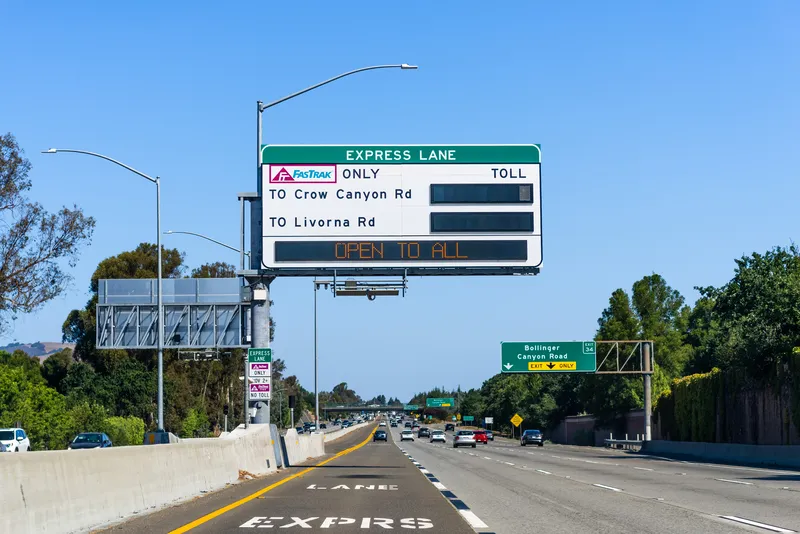
High-occupancy vehicle verification is a key part of enforcement (© Andreistanescu | Dreamstime.com)

Rideflag Technologies is working with the San Francisco Bay Area Metropolitan Transportation Commission (MTC) on a multi-phased deployment of its high-occupancy vehicle (HOV) verification tool.

The Canadian company, based in the province of Ontario, recently showcased its occupancy detection smartphone app at the IBTTA Annual Meeting and Exhibition in Seattle in the US.

The Bay Area Express Lanes are a local network of managed lanes that are currently being implemented across the interstate highway through close coordination among regional agencies. 

Rideflag says that the applicability of its technology is particularly relevant for MTC as the agency is planning to deploy the tool on one of the largest Express lane networks in the world, in addition to San Francisco’s Golden Gate and Oakland Bay bridges. MTC has around 125 lane-miles of operating Express Lanes in an overall planned regional network of 737 lane-miles.

Rideflag’s vehicle occupancy detection (VOD) camera technology accurately counts and verifies vehicle occupants. Using only one smartphone, carpoolers can declare and verify their occupancy in around five seconds or less. Verification can be completed with a face mask, sunglasses, in all lighting conditions and with children.

As well, the technology can be integrated with agency back-office systems through an API call or can directly connect with transponder readers. The app can also fully integrate with advanced agency customer relationship management tools.

Importantly, says Rideflag, while the technology counts the number of occupants within a vehicle and determines whether they are real, it cannot determine occupant identity.

The technology also does not continuously track a user’s location. It looks only at their route on the highway. The location data is gathered only in order to grant the correct HOV benefits to carpoolers.

RideFlag Technologies is partnering with the University of South Florida in the US and which received a research grant from the National Institute for Congestion Reduction.

In collaboration with the Center for Urban Transportation Research at the university, Rideflag’s VOD smartphone app is being tested on multiple express lane facilities to help further improve the technology and optimise its impact on creating new and sustained carpools.


For more information on companies in this article

Related Content

  • Connexionz awarded contract to connect multiple transit agencies across three States
    November 22, 2017
    Provider of smart transit innovations Connexionz has been awarded a contract to deliver multi-agency regional passenger information system to connect several transport networks across three US States. It will initially manage and support seven partner agency fleets, with potential to scale and link up to 18 separate transport operators across Washington, Oregon and Idaho. Called iTransit NM it is designed with the intention of enabling passengers convenient access to real-time information on all rural and
  • Meeting the challenges of smartcard fare payment
    July 4, 2012
    David Crawford monitors a growing trend in contactless smartcard ticketing The north east United States has become a hive of activity in the smart fare payment arena. In October 2011, the New York Metropolitan Transportation Authority (MTA) published, as a preliminary to an imminent procurement process, the detailed concept of its New Fare Payment System (NFPS). Based on open payment industry standards, this is designed to be implemented on all MTA bus and subway services operated by New York City Transit (
  • Parsons Brinckerhoff to modernise Michigan freeway
    July 4, 2014
    Parsons Brinckerhoff has been awarded a contract to assist the Michigan Department of Transportation (DOT) with the delivery of a project to modernise an 18-mile section of the I-75 freeway in Oakland County, Michigan. The US$850 million project, which runs from Auburn Hills to Hazel Park, involves reconstruction of the highway along with the addition of the first high-occupancy vehicle (HOV) lanes in Michigan. The project includes replacement of 51 bridges, reconstructing existing road surface, improvin
  • San Francisco launches congestion management strategy
    December 11, 2014
    San Francisco mayor Edwin M. Lee has launched the city’s congestion management strategy to improve traffic flow and safety, especially in the South of Market neighbourhood where construction and growth remain the highest in the City. The strategy outlines additional efforts the city could undertake, beyond traditional approaches such as the Interdepartmental Staff Committee on Traffic and Transportation (ISCOTT). These additional efforts include smarter traffic enforcement, better construction permitt



