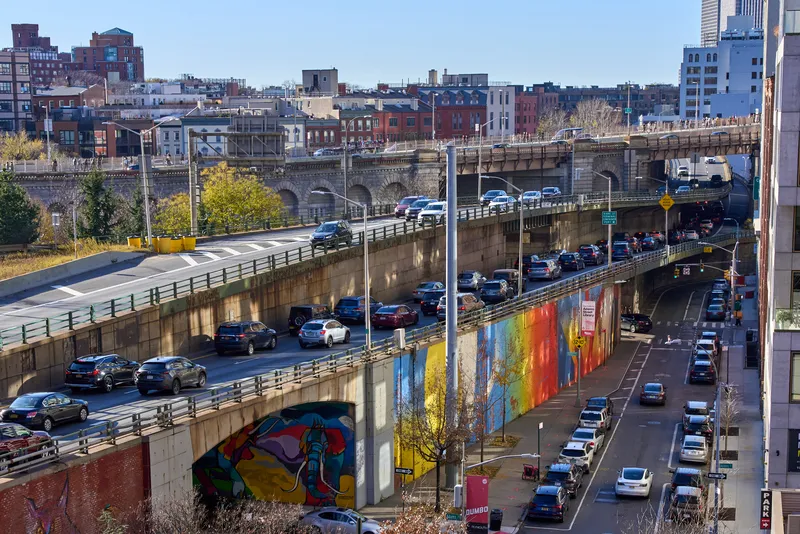
More than 250,000 bridges in the US are more than 50 years old and have exceeded their designated lifetime; 150,000 of them are already classified as deficient or obsolete. But as bridges are notorious bottlenecks, closures always lead to serious traffic disruption - that’s why cities like New York are turning to technologies like Weigh in Motion (WiM). In July 2023, New York governor Kathy Hochul signed a bill allowing the use of WiM on city-owned portions of the Brooklyn-Queens Expressway (BQE) - a triple cantilever built in the mid-20th century - to help enforce truck weight limits. The New York City Department of Transportation can issue tickets based on the WiM data alone – the first time direct weight enforcement has been used in the US.
“Many were not just barely overloaded – they were terribly overloaded”
“Once the WiM system was installed, it revealed that one overloaded truck per minute was crossing the bridge,” says JT. Kirkpatrick, sales manager North America traffic solutions at Kistler. “Many were not just barely overloaded – they were terribly overloaded.” Ahead of enforcement, the NYCDoT issued 90 days of warnings to help drivers adjust.
The effect was immediate and overweight traffic dropped by 64%; in the following six months, after citations began, the number dropped by another 50% compared to the post-warning period. Overall, the city saw an 82% reduction in overweight vehicles crossing the bridge.
At the same time, NYCDoT uses the gathered data to calculate the current life expectancy of the BQE. Information on whether overloaded trucks are crossing, how many are using the bridge and when the peak times are, result in an accurate traffic load analysis that forms the basis for the calculation.
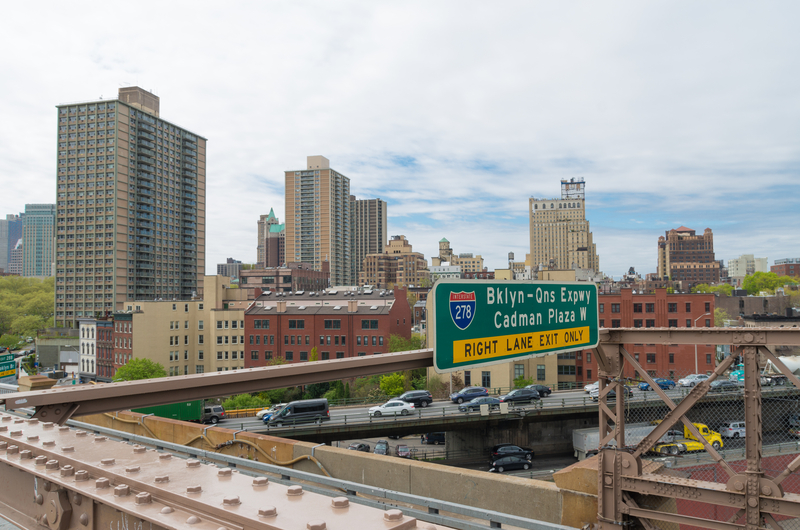
Structural health monitoring
While enforcement tackles the issue of overloaded vehicles directly, structural health monitoring (SHM) plays a crucial role in ensuring the long-term safety of bridges by continuously monitoring their condition. The measurement systems, based on accelerometers, strain gauge, and other kinds of sensors, record movements and vibrations, providing information on stress and possible corrosion of the structure caused by traffic, wind and temperature fluctuations.
Bridge engineers must place sensors at key points: some of the accelerometers measure vibrations in the centre of the concrete piers. Others are distributed throughout the structure to monitor any significant changes in the bridge’s natural frequency, which indicates possible damage. The sensitivity, frequency range, temperature stability and linearity of the sensors are essential to the quality of the results: these are stored in the cloud in real time, allowing engineers to assess the bridge anytime. “Combined with the associated evaluation and analysis systems, short-term condition monitoring gives bridge owners a picture of its condition and probability of failure,” explains Kirkpatrick.
“This is important as a reliable basis for a predictive analysis of how funds should be best invested. Long-term bridge monitoring provides more information, enabling authorities and bridge owners to continuously and reliably monitor the condition of bridges and support the planning of maintenance activities through to new construction.”
AI technology meets bridge protection
WiM combined with SHM gives bridge engineers an even better solution, Kirkpatrick believes: “On the one hand, bridge engineers have the products to monitor bridge movement, vibration, and deflection; and on the other hand, they can collect live total loads and even specific data from overloaded trucks in real time. This helps in the subsequent step of reliably calculating the remaining life expectancy of a bridge, rather than just using load assumptions based on standards.” It also provides bridge owners with critical information, such as whether traffic can be safely diverted to one side of the bridge.
AI technology makes it possible to aggregate and analyse large amounts of data, enabling data-based traffic management that could help keep roads, highways and bridges - as well as everybody using them - safe. “In the future, AI in combination with a network of cameras could provide even more data,” concludes Kirkpatrick. “For instance, transport authorities could discover exact routes taken by overloaded vehicles, or track down uninsured motorists and send them a ticket.”